Shopify Editions Fall 2026: What Lands in Australia, and What B2B Merchants Still Don’t Get
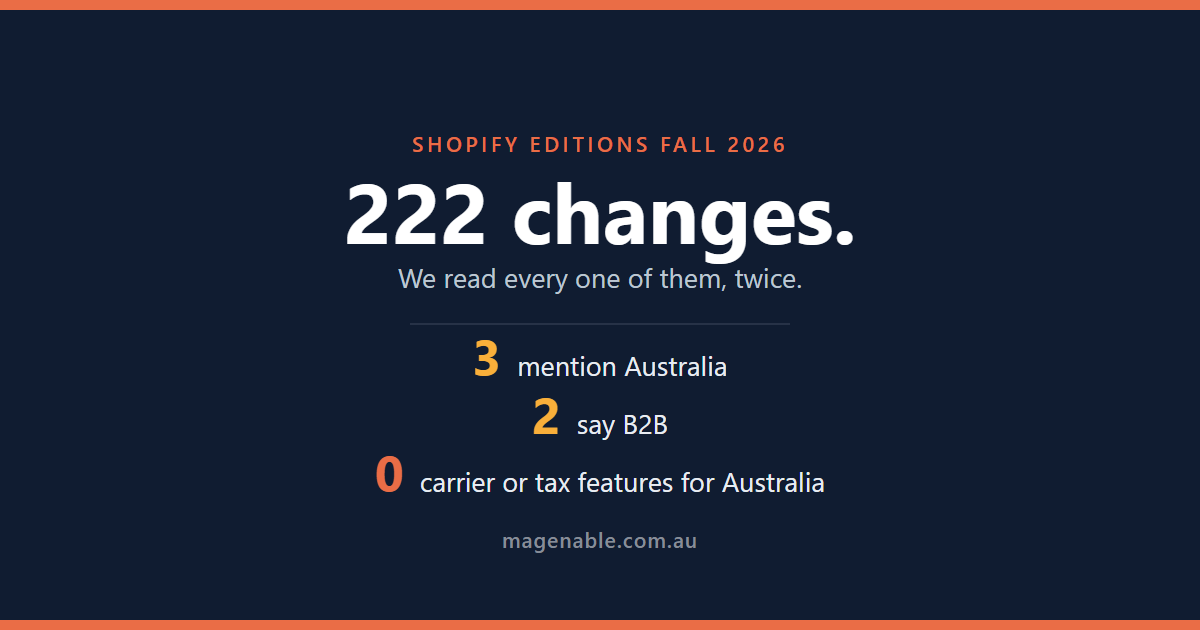
Shopify published its Fall 2026 Editions page in late October. We counted the announcements on it: 222. That is a lot of release notes dressed as a product launch, and reading it end to end is a genuinely unreasonable way to spend a morning.
So we read it for you, with two questions in hand rather than one. Not “what is new,” which Shopify answers perfectly well itself, but:
- Does this actually work in Australia?
- Does this help a merchant selling to other businesses?
Both answers were narrower than we expected. Australia is named three times in the entire release. Exactly two announcements carry a B2B label, and one of those is “install a third-party app.” Those two facts are the story, and neither of them is on the Editions page.
The headline is agentic, and that part really is global
The centre of gravity in this edition is shopping done by software. Shopify now publishes a Shop skill — a shop.md file that lets “ChatGPT, Claude, or other agents” discover products, get recommendations and check out with Shop Pay. Shop Pay works as a wallet inside Muse, Claude Duet, Grok Bot and Instinct. You can sell inside Google Search, including AI Mode, and the Gemini app, with checkout powered by Shopify and orders landing in your normal admin. WebMCP tools let a store register structured tools that agents can call to browse, build a cart and move through checkout.
One item deserves more attention than it will get. Under “your business details in AI channels,” Shopify now lets you review and approve the facts shared with agents, including policies and FAQs. That is a merchant-controlled answer layer, and it is the same bet we have been making on the Adobe Commerce side: what determines whether an agent can represent your product correctly is whether the answer exists somewhere machine-readable, in words you approved.
None of this is Australia-gated. An agentic surface does not care which hemisphere your warehouse is in. If you want the longer argument for why this matters, we wrote about MCP for online stores earlier this year.
That is the good news, and it is genuinely good. Now the part nobody else will write up.
What Australian merchants actually get
Australia appears by name three times:
- Shop Pay Installments is coming to Australia. Flagged early access. Interesting mostly because this is Afterpay’s home market, and buy-now-pay-later here is not a greenfield.
- Payouts in more currencies through Shopify Payments, in Australia, France, Singapore and Hong Kong — exclusive to Advanced and Shopify Plus plans. Useful if you sell cross-border and are tired of converting twice.
- Shop Campaigns in 35-plus new markets, listing “the UK, Australia, EU, and more.” You pay only when an ad drives a sale.
Beyond those three, the items that matter most to an Australian merchant are the ones aimed at selling out of Australia. Shopify Managed Markets now offers all-in international pricing with guaranteed duties and taxes plus flat-rate shipping at checkout. Per-market fees on products and collections can be collected automatically at checkout, with financial reporting attached (early access). Catalogue rollouts let you schedule price and publishing changes across markets and roll them back automatically when a promotion ends. Cart preview by market is coming soon.
And the biggest one, if you sell into the United States: Shopify Tax managed mode, where Shopify calculates tax at checkout, collects it, and remits it to each state. Read the fine print, though — the page says this is “for businesses new to the platform.” If you have been on Shopify for three years, this announcement is not addressed to you.
On the operations side there is real value that is not region-locked: stronger predictive search, where Shopify reports add-to-carts from search improving by 8%; more accurate session measurement with bot filtering and consent-aware counting, which quietly makes every conversion rate you report more honest; the Shopify Protect fraud suite, with pre-order blocking, AI-assisted dispute responses and custom fraud rules — though the page notes “features rolling out soon”; and POS support for Alipay, WeChat Pay, Satispay, Scalapay and GrabPay, which is more relevant to Australian bricks-and-mortar retail than it might first appear.
What Australian merchants don’t get
Here is the map of this edition’s tax and shipping work.

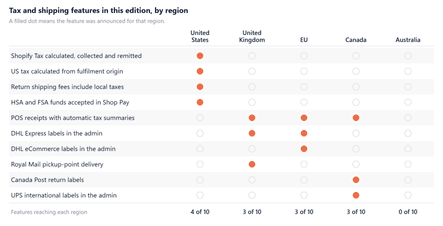
Four features for the United States. Three each for the UK, the EU and Canada. Zero for Australia.
The individual items are reasonable enough on their own. US sales tax calculated from fulfilment origin. Return shipping fees in the US that include jurisdiction-specific taxes. DHL Express labels in the admin for the UK, France, Italy, Germany and Spain. DHL eCommerce labels for the Netherlands and Poland. Royal Mail pickup-point delivery in the UK. Canada Post return labels, billed only when scanned. UPS international labels for Canadian businesses, customs documents generated for you.
Put them side by side and the pattern is hard to miss. Every piece of carrier integration and tax plumbing in this release went to the Northern Hemisphere.
The detail we keep coming back to is the POS receipt template, which “auto-adds tax summaries for the EU, UK, and Canada.” A customisable, compliant receipt is a genuinely useful thing for a retailer. Australian merchants are not in that list. In fact, we searched the entire page — all 1.1 megabytes of markup — for the letters GST. There is exactly one match, and it is three characters inside a JavaScript filename hash.
We want to be fair about what this does and does not mean. Shopify works perfectly well in Australia today; GST has been handled for years, and nothing here breaks. This is not a regression. It is a statement about where the next increment of investment went, and Australian compliance and logistics were not on the list this cycle. If your 2027 plan assumed Shopify would close the gap between what a US merchant gets natively and what you fill with apps and manual process, this edition is evidence against that assumption.
B2B: two announcements wore the label
We searched the page for B2B the same way. Out of 222 announcements, two are explicitly labelled.

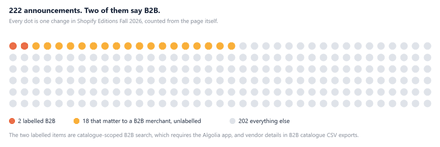
The first: B2B customers can see search results limited to their own catalogue, at the price they negotiated — using the Algolia app. That is a real improvement to a real problem, and it is also Shopify announcing that you should install somebody else’s software.
The second: CSV exports of B2B catalogues now show vendor details in every row, and you can filter by vendor to update pricing faster. A good quality-of-life fix for whoever maintains your price lists. Not a platform capability.
That is the complete list of things this edition says are for B2B.
What a B2B merchant actually got
The label is not the whole story. Dig through the unlabelled announcements and roughly eighteen more are directly useful to a business selling to businesses — they are just filed under Orders, Payments, Analytics and Developer instead.

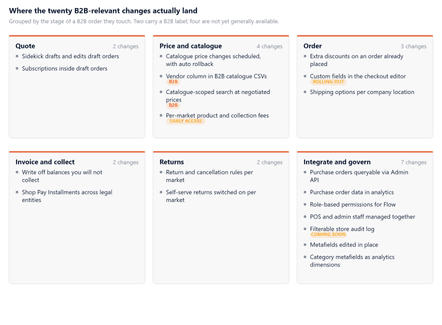
Grouped by the stage of a B2B order they touch, the picture is lopsided in an instructive way.
Quoting is thin but moving. Sidekick can now create and edit draft orders, with changes highlighted for review before you save. Draft orders can carry subscriptions, and you can send the customer an invoice to complete payment at checkout. Draft orders are where B2B quoting actually happens in Shopify, so any investment there counts.
Pricing and catalogues got the most attention. Scheduled catalogue changes with automatic rollback is the standout — if you have ever run a trade promotion and forgotten to put prices back, you know exactly what that is worth.
Ordering picked up two long-standing gaps. You can apply additional discounts to an order already placed, with totals and allocations recalculating automatically — which is what happens when a rep negotiates after the fact. And custom fields are arriving in the checkout and accounts editor: text inputs, date pickers, check boxes and choice lists. Shopify’s examples are delivery instructions and gift messages. The obvious B2B use is a purchase order number, and the absence of a native field for one has irritated wholesalers for years. Flagged rolling out soon.
Receivables got a genuinely grown-up feature. You can waive an order balance you do not intend to collect, with a write-off that keeps financials and tax records accurate. That is accounts-receivable thinking, and it is the kind of thing that usually signals a platform taking credit terms seriously.
Integration is where the real news is. Purchase orders are now queryable through the Admin API — line items, statuses, the lot — explicitly framed as “integrating procurement with your ERP and inventory apps.” Purchase order data also lands in analytics with supplier, cost and transfer details, filterable and exportable. For anyone running Shopify alongside a real ERP, these two are worth more than the labelled B2B items.
Governance is improving, with an asterisk. Shopify Flow gets role-based permissions, version history and an AI toolkit. POS and admin staff are managed together, with seasonal staff controls and multi-role support — but organisation-level roles are exclusive to Shopify Plus. A filterable store audit log, attributing every change to a staff member, app or service, is coming soon.
What this edition did not fix for B2B
Shipping options can now be configured per region or company location, which is a quiet but welcome nod to how B2B accounts are actually structured. Return and cancellation rules can be set per market, with return window overrides for products and collections, and self-serve returns can be switched on per market from the checkout editor.
What is not here: anything that changes the plan tier at which serious B2B becomes available. Company-level account structures, negotiated catalogue assignment and organisation-level governance remain where they were. If your B2B requirements were pushing you toward Shopify Plus before this edition, they still are. We went through those thresholds in detail in 7 Signs You’ve Outgrown Shopify, and nothing in Fall 2026 moves any of them. Our B2B platform comparison covers how the same requirements land on Adobe Commerce and BigCommerce.
Read the status labels before you plan around any of this
An Editions page is a marketing document, and it is easy to read the whole thing as shipped. It is not. Of the 222 announcements, 21 carry a status qualifier: twelve “coming soon,” four “rolling out,” four “early access” and one “in beta.”
Several of them are items we have just recommended:
- Shop Pay Installments in Australia — early access
- Per-market product and collection fees — early access
- Custom fields in checkout and accounts — rolling out soon
- Store audit log — coming soon
- Cart preview by market — coming soon
- HSA and FSA funds in Shop Pay — coming soon
- Shopify Protect chargeback coverage — coming soon
None of that makes them vapour. It does mean that a roadmap item resting on “custom checkout fields are in the Fall edition” needs a date from your account manager before it goes in a plan with a deadline attached.
What we would actually do about this
Four things, in the order we would do them.
Audit your agent-facing content before you touch anything else. The business-details approval flow in AI channels is the highest-leverage item in this release for most merchants, and it costs nothing but attention. Go and read what Shopify is currently telling agents about your policies and your products. Approve it deliberately.
If you sell into the US, price out managed tax properly. Then check whether you qualify, given the “new to the platform” wording. If you do not, the economic nexus problem you had last month is the one you still have.
If you are B2B, go straight to the Admin API purchase order work. Not the labelled B2B items. The procurement and ERP integration points are where this edition is strongest for you, and they are the ones that will not surface in any summary that filters on the word B2B.
Stop waiting for Australian logistics parity. This edition put every one of its carrier and tax integrations somewhere else. Budget for the apps and the process you already use, and treat any future Australian carrier announcement as upside rather than plan.
A note on where we stand
We build and support ecommerce on Shopify, Magento Open Source, Adobe Commerce and BigCommerce, and we have no stake in which one you choose. This is an assessment of one release, not an argument to migrate. Most of what is in Fall 2026 is good work, and the agentic layer in particular is ahead of where much of the industry is. Our point is narrower: if you are reading an Editions page from Melbourne, or reading it as a wholesaler, the headline numbers are not describing your situation, and it is worth knowing that before you plan around them.
If you want a read on what this means for your specific stack — Shopify or otherwise — get in touch.
Source: Shopify Editions Fall 2026, read 29 October 2026. Counts of announcements, regional availability and status labels were taken from the page markup on that date; Shopify revises Editions pages after launch, so figures may drift.