Agentic FAQ: Product Answers Humans and AI Agents Can Both Read
A shopper lands on a product page with one question in mind. Does this fit a standard cabinet? Is it safe for a dishwasher? What is actually in the box? The answer usually exists somewhere — in a spec table, in paragraph four of the description, in a PDF datasheet, or, often enough, baked into an image of a product label.
For a human, that is friction. They scroll, they squint, they open the PDF, or they leave and ask a competitor. For the growing share of shopping now done by software on a customer’s behalf, it is worse than friction. It is a dead end.
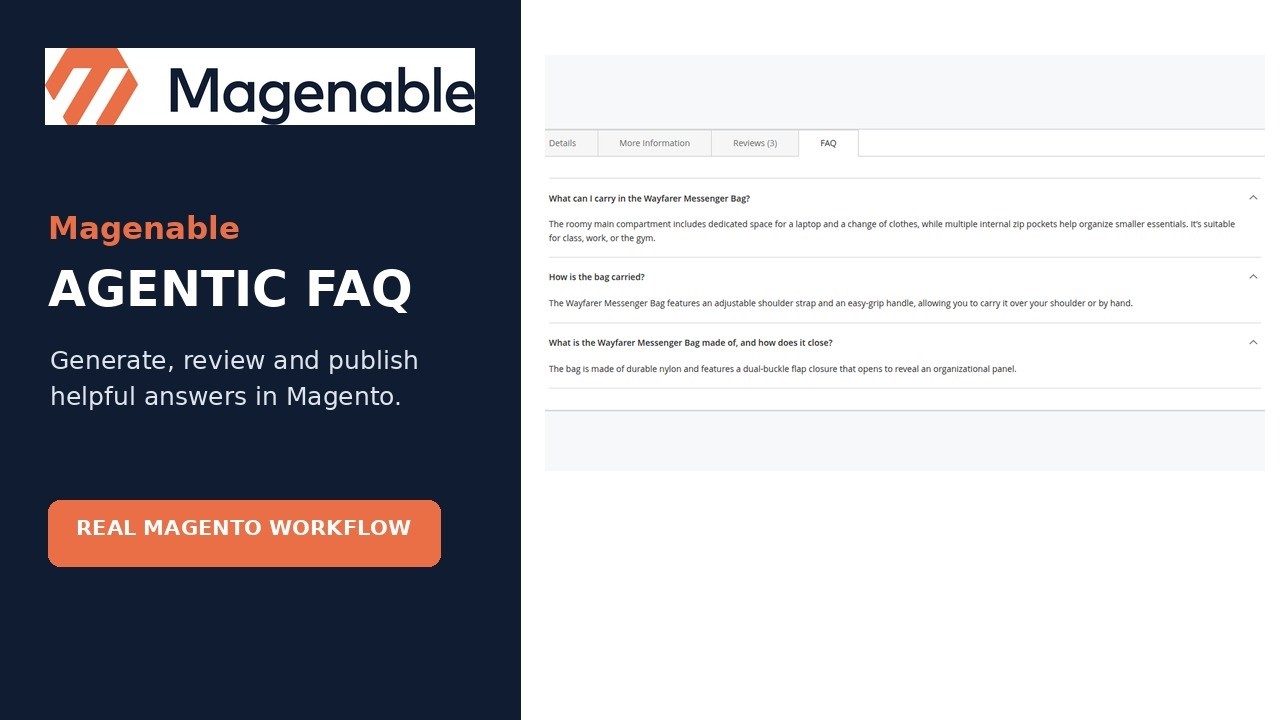
We have released a module to address this from both directions at once, now available on the Adobe Commerce Marketplace. Magenable Agentic FAQ adds product questions and answers to Magento 2 — written by hand or drafted by AI, edited and approved in the admin, and displayed to customers in an FAQ tab on the product page.
Agents read your page roughly the way a screen reader does
In September, AudioEye published a study that puts an uncomfortable number on something many of us had only assumed. They ran 1,560 independent AI agents, built from six commercial models, across 13 real-world tasks on six websites, repeating each test ten times.
On the site with the worst accessibility problems, agents completed 31% of tasks. On an accessible version of that same site, they completed 96%. Task completion fell by roughly two-thirds for every single model tested. Median token use across all tests ran 128,000 without accessibility fixes against 90,000 with them — about 43% more compute to achieve less, and on the worst site every model burned at least twice as many tokens, with the most expensive model using six times.
The detail that should interest anyone who has ever shipped a spec sheet as a JPEG: in one task, the numbers an agent needed appeared only inside an image, with no text description in the code. Six models attempted it ten times each. All sixty attempts failed.
Two honest caveats, because they matter. This is vendor research — AudioEye sells accessibility products, and five of the six test sites varied only by whether AudioEye’s own fixes were loaded. The 96%-versus-31% figure is the worst site in the set, not an average across the web. The independent element was WebJudge, an open-source evaluator from Ohio State University’s NLP group, which agreed with AudioEye’s scoring 95% of the time; it validated the marking, not the study design.
Treat the exact percentages as directional, then. The mechanism underneath them is not really in dispute: an agent reaches your page through its rendered text and accessibility tree. Information that exists only as pixels, only inside a hover state, or only behind a JavaScript interaction is information the agent may not have.
Why the storefront output is deliberately boring
The FAQ block is added to product.info.details as a tab, alongside Details and Reviews. Inside it, each question is a native HTML <details> and <summary> element. Questions and answers are rendered as escaped text — HTML in an answer is not interpreted.
There is no JavaScript behind the accordion. The expanding and collapsing is the browser’s own. Here is what a rendered entry actually looks like:
<div class="agentic-faq" data-product-sku="WJ09">
  <details class="agentic-faq__item" data-faq-id="2">
    <summary class="agentic-faq__question">
      <span>Is the jacket water-resistant and quick-drying?</span>
    </summary>
    <div class="agentic-faq__answer">
      Yes. The 100% polyester jacket features a lightweight, quick-drying,
      water-resistant construction to help protect against light moisture.
    </div>
  </details>
</div>
That is the whole mechanism. The answer is a plain text node sitting in the markup whether the <details> is open or shut.
It is an unglamorous implementation choice and it is the most important one in the module. A <details> element is in the DOM regardless of its open state, it is exposed to the accessibility tree as a disclosure widget, and nothing has to execute before the content exists. A shopper using a screen reader gets it. A crawler gets it. An agent parsing the page gets it. Compare that with the common pattern of fetching FAQ content over AJAX when a question is clicked, which produces a page where the answers are simply absent until something runs.
The only script the block ships is a short inline listener for the optional analytics event, bound to the native toggle. Strip it out and the FAQ behaves exactly as before.
Entries are sorted by sort order, then by ID. Store-specific and global entries display together — a store-view-specific question does not replace a global one.
What it does in the admin
Agentic FAQ can read the product data you already hold and draft questions and answers specific to that product. Those drafts land in a form, not on the storefront. Nothing reaches a customer until a person has read it and pressed save.
- Manual or AI-drafted — a Creation Method toggle. The module is perfectly usable with the AI half switched off, and without the
generatepermission the AI mode is hidden entirely. - Attribute-scoped generation — you choose which product attributes go into the request. The default is name, short description and description. Attributes are loaded in the context of the store view you select, so a localised store view generates from localised data.
- A prompt you control — the instruction sent to the model is a configuration field you can edit. The shipped default ends with the line “Avoid inventing product specifications or features.”
- Review before publishing — generated questions and answers appear in the form for editing, with active state, sort order and store-view assignment per row.
- Central grid — all entries under Catalog, with filters, sorting, column selection and bulk deletion.
- Provenance recorded — each entry stores its source. Manual entries record
adminand the user’s name; generated entries record the provider code and the model. Edit the text of a generated answer and the source flips toadminwith your name — but change only its active state, sort order or store views and the original provenance is preserved. - Granular permissions — separate ACL resources for view, edit, delete, generate and config.
- An analytics event — expanding a question pushes an event to the
dataLayercarrying the product SKU and the FAQ’s ID. The event name is configurable, and you can choose whether to send the question text alongside the ID or the ID alone.
That last one deserves more attention than it will get. It means you can find out which questions people actually open — which is to say, which uncertainties your product pages are failing to resolve. That is a content backlog generated from behaviour rather than opinion, and it is the kind of thing we have argued before that merchants should measure instead of guessing at.
How the AI side is put together
The FAQ module does not talk to OpenAI. It asks magenable/module-ai for a provider, and a separate adapter module does the talking. OpenAI support comes from magenable/module-openai.
That indirection is there so the AI vendor is a swappable component rather than a hard dependency. Each adapter supplies its own model list and default; the FAQ module can either name a provider and model explicitly or inherit whatever the site’s general AI configuration specifies. If you later want to run this against a different vendor, or against a model hosted somewhere you control, the FAQ module does not change.
On model choice: our own testing found OpenAI’s GPT-6 Luna (gpt-6-luna), the lower-cost tier of the GPT-6 family, entirely adequate here. Writing a product FAQ is a summarising job over data you have already supplied, not a reasoning problem, so reaching for the most expensive model on the list is unlikely to repay the token cost. Start low, read the output, move up only if it disappoints.
Installation and user guides are published with the Adobe Commerce Marketplace listing.
Four things worth knowing before you install
We would rather tell you these than have you discover them.
Variant FAQs are not inherited by the parent. The storefront requests FAQs for the current product ID. Assign a question to a configurable variant and the parent configurable product will not show it. Put FAQs on the product customers actually land on.
It will not invent facts you have not given it. Answers are generated from the attributes you nominate — and the default prompt explicitly tells the model not to invent specifications. If an attribute is empty, wrong or inconsistent across the catalogue, the FAQ will reflect that. Thin product data produces thin FAQs, rather faster than before.
A word on FAQ schema, since someone will ask
If you have read anything about FAQ markup in the last few years, you have probably read that it earns you an expanded listing in Google. It does not, and has not for some time.
Google limited FAQ rich results to well-known, authoritative government and health sites in September 2023. In May 2026 it removed the feature: the deprecation notice stated it “will no longer appear in Google Search starting May 7, 2026,” and the documentation now records that the FAQ rich result is no longer shown in Google Search results. The search appearance, the rich-result report and Rich Results Test support were dropped in June 2026, with Search Console API support removed that August.
The FAQPage type itself is not deprecated — it remains valid markup. It simply will not win you a rich result in Google, and we would rather say so plainly than sell you a snippet that no longer exists.
Which is why the argument for this module does not rest on schema. It rests on the answers existing as real, visible, script-free text in the product page’s markup. That is what helps a shopper who is deciding, and it is what an agent can actually parse. Structured data gives machines clues about meaning; it does not guarantee crawling, indexing, rankings, AI citations or traffic. Nobody’s extension can promise those, and you should be sceptical of any that does.
Worth keeping one more figure in view: roughly 55% of shoppers now research with AI, but only about 5% buy on its recommendation. Being readable by machines is necessary. It is not yet the same as being bought.
Availability
Agentic FAQ 1.0.0 is approved and available on the Adobe Commerce Marketplace. It is compatible with the 2.4 release line of Magento Open Source, Adobe Commerce (on-prem) and Adobe Commerce (cloud), and it passed every check in Adobe’s quality report: installation and Varnish, coding standard, plagiarism, malware, marketing review and manual testing.
The licence is US$199 for Magento Open Source and US$299 for Adobe Commerce, on-prem or cloud. Installation and a 12-month service agreement can be added at checkout. AI generation is optional: OpenAI usage is billed to your own OpenAI account and is not included in the price.
If you want to see it against your own catalogue rather than Magento’s sample data, get in touch. The most useful thing you can bring to that conversation is a handful of products whose questions you already know you answer badly.
Sources: AudioEye, “AudioEye Study Finds up to 68% Drop in AI Agent Task Completion on Inaccessible Websites,” 24 September 2026; Google Search Central, FAQPage structured data documentation and changelog.