If your current ecommerce platform has started to feel like something you’re working around rather than working with, you’re not alone. Company accounts held together with workarounds. Quotes handled over email because the platform can’t do them natively. Credit terms and invoice payment bolted on as an afterthought. These are usually the first signs that a platform review is overdue.
The trouble is, every vendor’s marketing page reads well. BigCommerce, Adobe Commerce, Magento Open Source and Shopify all claim to support B2B. What’s harder to find is a straight answer to the question that actually matters: which of these platforms handles your requirements natively, and where will you end up paying for extensions, integrations or custom development to get there?
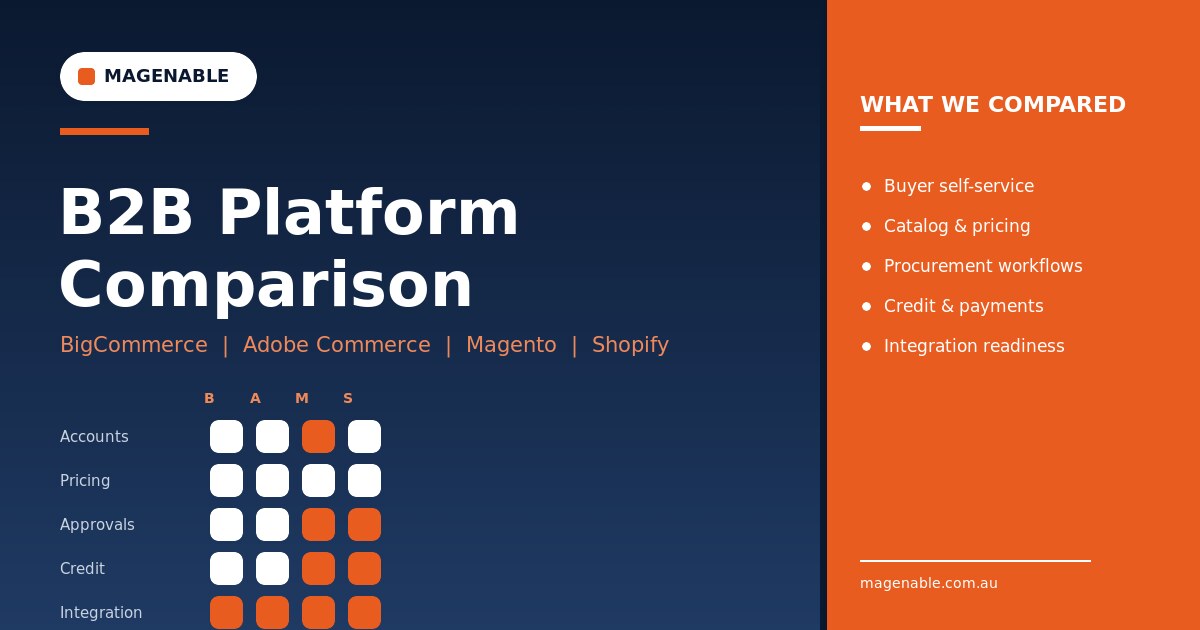
We put together a detailed capability briefing comparing these four platforms across the areas that actually decide whether a B2B implementation succeeds – buyer self-service, catalog and pricing, procurement workflows, credit and payments, and integration readiness. Here’s the practical summary, plus a link to download the full briefing at the end.
The platforms differ less on basic ecommerce, more on B2B depth
Here’s the core finding: all four platforms can run a competent online store. Where they genuinely diverge is how much organisational buying, procurement governance and accounts-receivable workflow they hand you without extra software.
That distinction matters more than it sounds. A saved shipping address isn’t the same as a company location with its own buyers, catalog, tax treatment, payment terms and permissions. Most platforms can do the first natively. Far fewer can do the second without an extension.
The four platforms, in brief
BigCommerce B2B Edition
Good fit when a comprehensive buyer portal and a shorter implementation path matter most. BigCommerce covers company accounts, shared shopping lists, quick order, quotes, invoice payment and sales-assisted ordering natively. Where it thins out: conditional approval rules are more limited than Adobe Commerce, and complex freight or account-specific logistics often need an app.
Adobe Commerce + B2B
The pick when complex buying organisations and procurement governance are driving the decision. It’s the strongest native combination of company hierarchy, custom roles, shared catalogs, negotiated quotes, conditional PO approval and company credit of the four. The trade-off is effort – implementation and ongoing operation take more work, and net-term collections or online settlement of old invoices may still need extensions or ERP integration.
Magento Open Source
Makes sense when owning your solution architecture outweighs having B2B breadth out of the box. The commerce foundations are solid – address books, wishlist, group and tier pricing, quantity rules, reordering, tax and invoice documents. But company accounts, RFQ, quick order, shared lists, approval and credit are all extension-led, and compatibility and upgrade ownership sit squarely with you.
Shopify B2B
Worth it when SaaS simplicity and B2B/DTC convergence matter more than deep procurement workflows. Native companies, locations, catalogs, quantity rules, Net terms, reordering, PO numbers and APIs give you a solid streamlined base. Apps are still common for company self-service, RFQ, procurement lists, approval, credit control, invoice documents and customer-specific checkout rules – and a few of the more advanced controls, like assigning a catalog directly to a company or location, are Shopify Plus-only.
Where the gaps actually show up
The full briefing scores each platform across roughly 40 individual capabilities in five categories. A few patterns are worth calling out.
On accounts and organisation, BigCommerce and Adobe Commerce both handle company accounts, buyer permissions, multi-location structures and parent-child company hierarchy natively. Magento Open Source and Shopify need an extension for most of this, and Shopify has no packaged way to model a parent-child hierarchy of separate companies at all.
Ordering, lists and approvals is where the gap widens the most. Simple buyer-to-manager approval and conditional multi-level approval by value, SKU count or role are both native in Adobe Commerce. BigCommerce covers simple approval natively but has no packaged conditional approval. Magento Open Source and Shopify need extensions for both.
| Capability | BigCommerce | Adobe Commerce | Magento Open Source | Shopify B2B |
|---|---|---|---|---|
| Company account, multiple buyers | Core | Core | App/extension | Core |
| RFQ and negotiated quotes | Core | Core | App/extension | App/extension |
| Conditional multi-level approval | N/A | Core | App/extension | App/extension |
| Company credit limit & hold | Core | Core | App/extension | App/extension |
| Customer pays invoice online | Core | App/extension | App/extension | Core |
On credit, payments and invoicing, BigCommerce leads – buy-on-account, calculated Net terms, credit limits, consolidated invoice views and online invoice payment are all native. Adobe Commerce covers credit limits and company payment methods natively but pushes calculated due dates and online invoice payment to extensions. Worth knowing: no platform automates due-date reminders or dunning natively. That’s extension territory everywhere.
And on service and integration, none of the four ships PunchOut/cXML/OCI procurement, a packaged ERP or EDI connector, or customer-specific inventory allocation out of the box. If your business needs any of these, budget for integration work no matter which platform you land on.
Feature coverage is only one input
It’s tempting to treat the capability matrix as the whole decision. It isn’t. More native functionality doesn’t automatically mean better strategic fit. The right platform is the one that best balances business fit, technical fit, delivery risk and lifecycle economics – which means also weighing:
- Architecture and adaptability: extensibility, API maturity, hosting model, data portability and roadmap alignment.
- Delivery and ecosystem: extension quality, the local partner ecosystem, support maturity, and your own team’s technical capability.
- Risk and economics: stability and compliance, performance at scale, upgrade and release management, implementation complexity, and total lifecycle cost of ownership.
A starting shortlist by priority
| If your priority is… | Leading fit | Primary diligence point |
|---|---|---|
| Complex approval, hierarchy and corporate governance | Adobe Commerce | Delivery cost, operational capability, ERP boundary |
| Broad buyer portal, shorter route to value | BigCommerce | Approval depth, specialised freight rules |
| B2B and DTC on a streamlined SaaS platform | Shopify | App footprint, Plus-only capabilities, procurement complexity |
| Maximum code control, extension-led architecture | Magento Open Source | Extension governance, upgrade testing, total ownership cost |
Five questions worth answering before you commit
Whichever platforms make your shortlist, these are the questions from our own customer workshops that tend to separate a smooth implementation from a painful one:
- Is the commercial unit a customer, a location, a legal entity or a parent group?
- Which prices, products, payment terms, tax settings and freight rules need to vary by account?
- Is approval required before checkout, after PO submission, or inside an external procurement system?
- Which system owns credit, invoice status, available-to-promise inventory and customer master data – the ecommerce platform or the ERP?
- Which capabilities are launch-critical, and which can wait until your ERP and operational processes have settled down?
Get the full briefing
Everything above is a summary of a longer capability briefing we put together, covering all five categories in full detail – roughly 40 individual capabilities scored across all four platforms, plus the primary documentation and packaged extensions we referenced along the way.
Download the full B2B ecommerce platform comparison (PDF)
Where Magenable fits in
We work across all four of these platforms with Australian B2B businesses moving off legacy or outgrown ecommerce setups, and we put this comparison together because we kept having the same conversation with prospective clients: a feature list alone doesn’t answer “which platform is right for us.”
Treat this as an input into a broader evaluation, not a substitute for one. Final platform selection should rest on validated business requirements, technical and operational due diligence, implementation risk, and alignment with your long-term digital commerce strategy.
If you’re weighing up a platform change and want to turn this into a weighted requirements roadmap specific to your business, get in touch with the Magenable team. We can facilitate requirements discovery, platform fit analysis and delivery planning.