The ACCC is checking your countdown timers: a Black Friday and Boxing Day guide for online stores
Checked against ACCC media releases on 23 November 2026. This is general information, not legal advice.
Black Friday is this Friday, 27 November. Cyber Monday follows on the 30th, and Boxing Day lands a month later. Somewhere in that stretch, the ACCC will almost certainly look at your store.
On 10 November the regulator launched its third Black Friday sales sweep. For the first time, it covers websites, emails and social media, not just the homepage banner. And the tactics it lists are the ones most online stores switch on by default for a sale: countdown timers, “only 2 left” badges and strikethrough prices.
None of this means you should switch them off. It means each one has to be true.
What the 2026 sweep is looking for
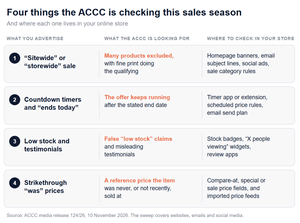
The ACCC named four kinds of claim:
- “Sitewide” or “storewide” sales when a large number of products are excluded.
- Time-limited offers and countdown timers when the offer continues past the stated end date.
- Pressure tactics, including misleading testimonials and scarcity messaging such as false claims that stock is low.
- Price comparisons against a misleading reference price, where the item was never, or not recently, sold at the “was” price.
The ACCC’s Deputy Chair also made a point that matters for anyone relying on terms and conditions: retailers “should not be relying on fine print disclaimers or exclusions to qualify the headline message of a promotion”.

What retailers have already paid for
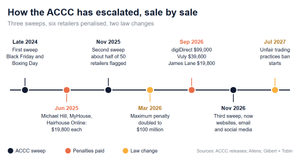
This is the third year of the sweep, and the earlier two led to real penalties. Each case below was settled by infringement notice. Paying one is not an admission of a breach, and digiDirect is the only retailer that also admitted its claims were misleading.
- “Sitewide” that wasn’t. In June 2025, Michael Hill, MyHouse and Hairhouse Online each paid $19,800. Michael Hill had advertised “Member Event 25% off Sitewide”, but some products weren’t in the sale. More than a quarter of Hairhouse Online’s products weren’t included in its “Save 20% to 50% sitewide” offer.
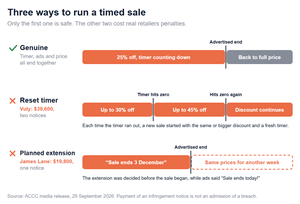
- A timer that kept resetting. In September 2026, Vuly Play Group paid $39,600 on two notices. When its Click Frenzy countdown ended, the discount rose from “up to 30% off” to “up to 45% off” with a new timer. When the Black Friday timer ended, the discount continued and the timer reset again.
- An end date that was never the end. In the same release, James Lane paid $19,800. Its sale was advertised to end on 3 December 2025, with “Sale ends today!”, but prices stayed discounted for another week. The ACCC found James Lane had decided to extend before the sale began.
- A “was” price nobody paid. Also in September 2026, digiDirect paid $99,000 on five notices. One example was a mini wireless keyboard at $149 with a struck-through $229, a price it had rarely advertised and almost never sold at. The ACCC first noticed this during a Black Friday sweep.

The fines in these cases look modest, but only because infringement notices are fixed amounts. Court proceedings are a different scale. Since 28 March 2026, the maximum penalty for a company under the Australian Consumer Law has been the greater of $100 million, three times the benefit obtained, or 30% of turnover during the breach period. That is double the previous $50 million.
Countdown timers: the one most stores get wrong
A countdown timer is only a claim about when the price ends. The problem is that the timer usually comes from an app or extension, the price from a scheduled price rule, and the email from a separate send plan. Nobody checks that all three agree.
- Use a fixed end time, the same for every visitor. Some timer apps offer “evergreen” or per-visitor timers that restart for each new session. By design, those can’t match a real sale end date.
- Don’t plan the extension in advance. That was the core of the James Lane case. If there is a real chance you’ll extend, don’t advertise a hard end date or say “ends today”.
- Don’t roll one sale into the next with a fresh timer. If the same or a better discount starts the moment the clock hits zero, the deadline wasn’t real. That was the Vuly pattern.
- Tie operational timers to operations. A dispatch cut-off countdown (“order in the next 2 hours for same-day dispatch”) is fine as long as the cut-off is real.
Our post on scarcity in ecommerce covers the honest versions of time, stock and price-window urgency in more detail, with Australian examples. Its rule of thumb holds up well against the ACCC’s list: if you can’t explain the scarcity signal operationally, don’t ship it.
Stock badges and “people viewing” widgets
This year’s sweep names “false claims that stock levels are low” and misleading testimonials. Both often come from conversion apps rather than from anyone’s deliberate decision.
- Drive “only X left” from live inventory. If stock syncs with a delay or comes from several warehouses, show “low stock” rather than an exact number that might be wrong.
- Check where “X people are viewing this” comes from. Some social-proof apps can show simulated or padded activity. If you can’t trace the number to real sessions, turn the widget off.
- Show reviews as they are. Don’t hide negative reviews or present selected testimonials as typical. Our social proof post covers why reviews and testimonials are so persuasive, which is exactly why they need to be genuine.
Strikethrough prices: where the “was” price comes from
Every major platform has a field for the struck-through price: compare-at price in Shopify, special price and catalogue price rules in Magento and Adobe Commerce, and sale price (with the default price struck through) or MSRP in BigCommerce. The platform will happily display whatever is in that field. It’s on you that the number is a price you actually charged, recently, for a meaningful period.
Watch for prices that arrive from a supplier feed or ERP with an RRP in the comparison field, and for prices raised shortly before a sale so the discount looks bigger. digiDirect’s case shows the ACCC looks at sales history, not just the label.
“Sitewide” and “up to”
If a meaningful share of the catalogue is excluded, don’t call it sitewide. Name the range instead (“30% off outdoor furniture”). For “up to X% off”, the ACCC’s earlier guidance says “up to” must be prominent and a real number of products must actually be at X% off, not one or two.
Emails and social posts count too
This is the first sweep to look beyond websites. A subject line saying “Last chance: ends tonight” is the same claim as a countdown timer. So is a “sitewide” Instagram story when the website has exclusions. Check that the email schedule and the social calendar match the real promotion dates.
What’s coming next: the unfair trading practices ban
From 1 July 2027, a new prohibition on unfair trading practices joins the Australian Consumer Law. It was passed by Parliament in July 2026. Law firm commentary, including Allens, describes it as aimed at “dark patterns”. Their examples include misleading countdown timers and low-stock cues that create false urgency, and “confirm shaming” pop-ups such as “No thanks, I prefer to pay full price”.
The practical difference: today’s cases turn on whether a claim was misleading. The new law will also look at whether a design pressures customers or distorts their decisions. A timer that is accurate but designed to rush people could come into scope. The same law adds rules on drip pricing and subscription cancellations.

A checklist for this week and Boxing Day
- Write down the real start and end time of every promotion, and make the timer, the price rule and the emails use those exact times.
- Turn off any evergreen or per-visitor timer modes.
- Decide now whether the sale might be extended. If it might, don’t advertise a hard end date.
- Only say “sitewide” if almost everything is included, and make any “up to” claim prominent.
- Connect stock badges to live inventory, and remove viewer counts you can’t trace to real data.
- Check every struck-through price against what you actually sold at recently, especially prices from feeds.
- Read your sale emails and social posts as if you were the ACCC: do they say the same thing as the website?
- Keep screenshots and your price history for the promotion period, so you can back up your claims if asked.
The ACCC’s own guidance on false or misleading claims is short and worth reading before you schedule anything.
Want a second pair of eyes before Boxing Day?
We work on Magento, Adobe Commerce, Shopify and BigCommerce stores, and most of the issues above live in settings we see every day: timer extensions, scheduled price rules, compare-at fields and stock display. If you’d like us to review your promotion setup before Boxing Day, get in touch.
Sources: ACCC media releases of 11 June 2025, 10 November 2025, 18 December 2025, 14 April 2026, 21 September 2026, 29 September 2026 and 10 November 2026 (124/26); Gilbert + Tobin on the penalty increase; Allens on the unfair trading practices regime. This article is general information, not legal advice. Get advice on your specific promotions.