Bending Spoons is buying Mailchimp: what merchants should do before anything changes
Research checked 20 November 2026. The acquisition has been announced, not completed.
If Mailchimp only sends your newsletter, moving to another provider is manageable. If your store’s whole marketing automation is built around it, running your welcome series, abandoned-cart reminders and post-purchase journeys, you depend on it for much more than a contact list.
Intuit has agreed to sell Mailchimp to Bending Spoons. The buyer has a record of raising prices at the businesses it acquires, so this acquisition is a good reason to review your options. On its own, it is not a reason to switch tomorrow.
The useful question is: could you move your marketing automations safely if the price or service stopped making sense?
What has actually been announced?
In its 19 November 2026 announcement, Bending Spoons said it had agreed to buy Mailchimp in an all-cash deal at an enterprise value of US$3.68 billion. Intuit will put US$368 million of the proceeds back into Bending Spoons shares. Completion is expected in early 2027, subject to regulatory approvals and other closing conditions.
Bending Spoons’ CEO said the company will “invest substantially in the business” after closing. The announcement says nothing about Mailchimp prices, features or a deadline for customers to move. Until the deal closes, Intuit still owns Mailchimp, so nothing should change for customers before early 2027.
Why the pricing concern is reasonable
The clearest evidence comes from Bending Spoons itself. In the same announcement, it says its transformations of acquired businesses typically include reorganising teams, overhauling technology and “enhancing marketing and monetization”. It also says it has never sold a material business, so this would be a long-term owner.
The track record matches. After Bending Spoons took over Evernote, the April 2023 pricing announcement set the US Personal annual plan at US$129.99, up from the US$69.99 set in 2016. To be fair, Evernote said this was the first increase in almost seven years for most subscribers, and the same announcement launched real-time editing and reworked synchronisation. Higher prices and product investment can arrive together.
A November 2025 investigation by Follow the Money reported that Meetup costs for organisers more than doubled after the takeover, and that one WeTransfer customer’s plan went from €10 to €23 a month. The same investigation reported deep staff cuts at several acquired businesses, including WeTransfer and Komoot. Interviewed for the piece, CEO Luca Ferrari agreed that the company often raises prices for the heaviest users, while arguing that it also improves the product’s value.
Staff cuts matter to merchants as much as prices do: support response times, integration maintenance and product roadmaps all depend on people. So the practical conclusion is: price, packaging and support changes are a credible risk worth preparing for, but Mailchimp’s future terms are unknown.
Your contact list is not your automation system
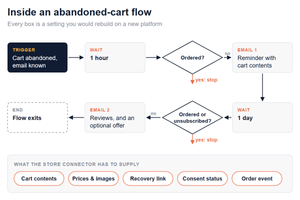
Consider an abandoned-cart sequence. It needs to know that a cart exists, who may lawfully receive a reminder, which products are in it and where the recovery link should go. It also needs to notice a completed purchase and stop sending.
A welcome series has its own rules: when someone enters, whether they have already bought, which offer they get, and whether another campaign takes priority. Post-purchase emails may depend on product categories, fulfilment status or repeat-order timing.

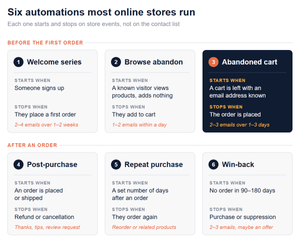
Moving these journeys means moving behaviour, not just addresses.
| Journey | What a replacement needs to preserve |
|---|---|
| Welcome series | Signup source, permission status, timing, purchase exclusions and offer rules |
| Cart recovery | Cart events, customer identification, recovery links and purchase-triggered exits |
| Post-purchase | Order events, relevant product data, delays and cancellation/refund handling where used |
| Win-back | Last-purchase logic, exclusions, frequency limits and suppression rules |
Those inputs come from your store connector. On Magento and Adobe Commerce, that is usually the Mailchimp for Adobe Commerce extension built by Ebizmarts. That connector is a dependency in its own right, and any replacement platform needs one that sends the same events.

Six things merchants can do now
1. Document the journeys that actually matter
List every active automation: its trigger, waiting periods, messages, audience rules, exclusions and exit conditions. Record who owns it and how it connects to the store.
This step matters more than it looks. Mailchimp’s account export documentation does not mention automations or Customer Journeys at all, so screenshots and written notes may be the only record you have. Start with the flows that would do the most damage if they stopped or misfired.
2. Preserve data without losing permissions
Run an account export and inspect what you get. It includes subscribed, unsubscribed and cleaned contacts as separate files, plus campaign content, templates, reports and e-commerce data linked to emails. It excludes website, landing-page and ad content. You can run only one export every 24 hours, so plan it rather than leaving it to the last day.

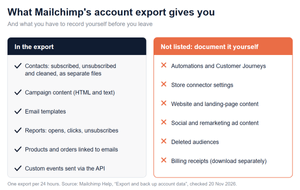
The unsubscribed and cleaned files are as important as the subscribed one. Import them into any new platform as suppressed, so nobody who opted out is emailed again by mistake.
Treat exports as sensitive customer data: restrict access, store them securely and decide how long to keep them.
3. Understand your real cost exposure
Record your current plan, renewal date, billable-contact rules, sending allowances and overage charges. Check which automation features sit in higher tiers.
When comparing alternatives, price the same contact count, sending volume and journeys. Include connector fees, implementation, support and maintenance. A low advertised starting price is not a like-for-like quote.
4. Check who sends each email, and your obligations
Identify whether Mailchimp (through its separate Mandrill transactional service), your commerce platform or a separate service sends order confirmations, shipping notices and other operational messages. Don’t remove a transactional-email dependency by accident during a marketing migration.
For Australian merchants, the Spam Act 2003 still applies whichever tool you use: you need consent, clear sender identification and a working unsubscribe that is honoured within five working days. Consent belongs to your relationship with the customer, not to the software. Changing tools doesn’t reset it, but you must carry every unsubscribe across. If the new provider stores data overseas, review your privacy policy against Australian Privacy Principle 8 on cross-border disclosure. And a promotional cart reminder shouldn’t be relabelled “transactional” to get around consent rules. This is general information, not legal advice.
5. Test an alternative with a contained journey
Use a test store where possible, or an isolated test audience and controlled events. Test the whole chain: event received, right customer matched, right message rendered, link working, and later messages stopped after a purchase or unsubscribe.
Also test duplicate events, delayed events, missing data and failed sends. A successful newsletter test does not validate cart recovery.
6. Plan the cutover before cancelling
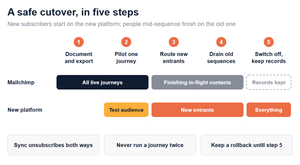
Decide what happens to people partway through a sequence. They shouldn’t restart a welcome offer or get cart reminders from both platforms.
Decide which system owns each journey, how unsubscribes stay in sync during any overlap, and how you would roll back. Keep access to historical records for as long as your reporting and retention obligations require.

Alternatives: three realistic paths
Another SaaS platform: usually the simplest starting point
Klaviyo is the most common choice for stores with serious automation needs. It covers welcome, abandoned-cart and post-purchase flows, and it integrates with all the popular commerce platforms: there is an official, free extension for Magento and Adobe Commerce, plus native integrations for Shopify and BigCommerce. Omnisend documents the same core journeys, with multi-step workflows and conditional logic.
Brevo and ActiveCampaign are broader automation platforms worth assessing against the workflows you need.
If your needs are simple, check what your commerce platform already includes before adding a subscription. Shopify merchants, for example, have Shopify Messaging for email and SMS. Native tools are usually lighter on segmentation and cross-channel journeys.
Whatever you shortlist, confirm the exact connector, the platform versions it supports, the events it sends, consent and unsubscribe sync, guest checkout behaviour, compatibility with any custom checkout, and who maintains it.
The trade-off: another SaaS provider keeps operational effort low, but it doesn’t remove vendor dependency or future pricing risk. Keep your data portable whichever provider you choose.
Open source: more control, not zero running cost
Mautic is an open-source marketing-automation platform you can host yourself. It is a credible option when control and extensibility matter and someone can own the operation: hosting, updates, security, backups, monitoring, store integration and email delivery, plus handling bounces, complaints and suppression.
listmonk is a self-hosted newsletter and mailing-list manager. It is excellent for newsletters, but it is not a replacement for event-driven commerce journeys such as cart recovery. If you go this route, you will need to invest in an integration layer: listmonk has an API and can send transactional emails, but something in the middle has to trigger them from store events.
What we did with our own newsletter
Earlier in November, before this deal was announced, we moved the Magenable newsletter off Mailchimp to a self-hosted listmonk install that sends through Amazon SES. Our case is the simple one: a monthly newsletter, no cart or post-purchase flows.
- Signup uses double opt-in with a CAPTCHA, and records the date, time and IP address of each confirmation as evidence of consent.
- We imported our ten previous issues into a public archive, so the back catalogue didn’t stay behind in Mailchimp.
- The first send went to a few hundred subscribers in about five minutes, with no bounces or complaints.
- One surprise: corporate link scanners click every link in an email soon after delivery, which inflates click counts. Judge early results with that in mind.
It took setup work that a SaaS tool would have done for us: domain authentication, a sending subdomain, the SES account and the subscription pages. For a newsletter, it was worth it. For a store running cart recovery, we would still start with a commerce-focused platform.
The trade-off: self-hosting increases control over the application and your data, but it swaps vendor dependency for technical and operational responsibility.
“Vibe-code our own”: useful for a narrow gap, risky as a wholesale replacement
AI-assisted development can quickly build a connector, data-quality check, report or tightly scoped workflow. That is valuable when an otherwise suitable platform is missing one capability.
A working prototype is not a dependable marketing service. Production needs reliable scheduling, retries, duplicate prevention, consent handling, unsubscribe processing, secure credentials, monitoring and recovery, and someone to maintain it when store APIs or email-provider rules change.
For most merchants, rebuilding a mature automation platform to save subscription fees is not the simplest way to reduce risk. A narrow custom integration around an established platform is the more realistic option.
Stay, pilot or migrate?
Stay and prepare if Mailchimp is reliable, fairly priced for your volume and well integrated with your store. Documenting your journeys is still worth doing. If you were already considering a move, this may be the final push.
Pilot an alternative if your costs are hard to predict, key journeys are constrained or your integration is fragile. Base the decision on a contained test, not a feature checklist.
Plan a migration when there is a concrete business case and a tested destination. Compare the cost of staying with the full cost and disruption of moving, not just the next provider’s monthly fee.
When to look again: at completion, expected in early 2027, and before your next Mailchimp renewal. Those are the points where any change in terms would show up.
The bottom line
Bending Spoons’ track record makes a review of your Mailchimp dependency sensible. It doesn’t mean a price increase or service change is coming.
Do not panic-migrate. Make staying a choice.
Know which journeys matter, keep the records you need and test alternatives before you need them. That preparation pays off even if you never leave Mailchimp.
If you’d like a hand, and a disclosure
We help merchants on Magento, Adobe Commerce, Shopify and BigCommerce with exactly this: working out what Mailchimp actually does for the store today, choosing where to go, and moving journeys and subscribers across without double-sends or lost unsubscribes.
In fairness to you: Magenable is an official Klaviyo partner, and the Klaviyo link in this article is a partner link. Weigh what we say about Klaviyo with that in mind. If staying with Mailchimp, or a different platform, suits your store better, we’ll tell you so. Get in touch if you’d like to talk it through.
This article is Magenable commentary, not a certification of the platforms mentioned or legal advice. Vendor capabilities were checked against the linked official pages; plan entitlements, prices and store compatibility need individual verification. Magenable is a Klaviyo partner and has no affiliation with Mailchimp, Intuit or Bending Spoons. Mailchimp® is a registered trademark of The Rocket Science Group.