Magento AI Discovery Without the Hype: A Practical Guide for Merchants

AI is starting to change how people discover products online.
Shoppers are no longer only typing short keywords into Google and browsing a list of blue links. They are asking longer questions, comparing products in AI tools, using conversational search, and expecting quick recommendations based on price, availability, features, reviews and delivery options.
For Magento Open Source and Adobe Commerce merchants, this raises a practical question:
Will AI search tools understand your store, your products and your offer clearly enough to include you when customers are researching what to buy?
That is where AI discovery comes in.
This article deliberately avoids overusing terms like AEO, GEO or “answer engine optimisation”. Those terms may be useful inside the SEO industry, but for merchants the goal is simpler: make your catalogue easy for search engines, shopping platforms and AI systems to crawl, understand, verify and keep up to date.
There is no magic shortcut. But there are practical steps Magento merchants can take now.
AI discovery is not a replacement for SEO
The first thing to understand is that AI discovery is not a completely separate discipline from SEO.
Google’s own guidance says that the best practices for SEO remain relevant for AI features such as AI Overviews and AI Mode. Google also says there are no additional technical requirements, special AI files, or special schema.org markup required to appear in those AI features. The page still needs to be crawlable, indexable, eligible for snippets, and useful to users.
Google has also warned against overfocusing on “AEO/GEO hacks” such as special AI text files, content chunking, or AI-only markup for Google Search. From Google’s point of view, optimising for generative AI search is still grounded in SEO fundamentals.
For ecommerce, this means AI discovery should be viewed as an extension of good SEO and good product data management.
The goal is not to trick AI systems. The goal is to make your product information clear, consistent and trustworthy.
What AI discovery means for Magento merchants
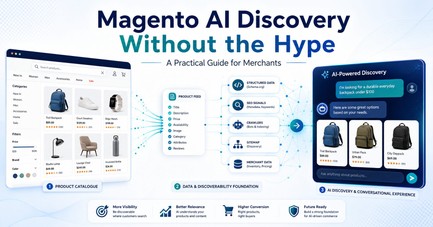
For a Magento or Adobe Commerce store, AI discovery depends on five foundations:
- Search and AI crawlers can access the right public pages.
- Product pages clearly explain what is being sold.
- Structured data matches what customers see on the page.
- Product feeds are accurate and updated frequently enough.
- Magento-specific catalogue complexity is handled properly.
That last point is important. Magento stores are often more complex than simple SaaS stores. They may have configurable products, child SKUs, MSI inventory, multiple websites, B2B price lists, customer group pricing, custom checkout rules, ERP integrations, layered navigation, multi-currency pricing and country-specific catalogue rules.
AI discovery will not fix those issues. In fact, it can expose them faster.
If the product page says one thing, structured data says another, Google Merchant Center has a third value, and an AI product feed has a fourth value, AI systems have less reason to trust the information.
Start with crawl access
Before worrying about ChatGPT, Perplexity or any new AI search experience, check whether crawlers can access your important catalogue pages.
In Adobe Commerce, robots.txt and sitemap.xml need to be configured carefully, especially on Adobe Commerce Cloud and multi-site implementations. Adobe’s own best-practice documentation says these files help crawlers understand how to crawl the site and can improve both performance and SEO. It also recommends testing that the generated files are visible from the expected root paths.
For Magento merchants, the crawl audit should include:
robots.txton every live domain.- XML sitemaps for products, categories and CMS pages.
- Canonical tags on product and category pages.
- Meta robots settings.
- CDN and WAF rules in Fastly, Cloudflare, Akamai or similar tools.
- Whether product images, CSS and JavaScript are accessible.
- Whether old staging or development rules have leaked into production.
- Whether important product pages return clean
200responses to allowed crawlers.
This is not only about Googlebot. AI-related crawlers and user agents are becoming part of the discovery mix.
Understand AI crawlers before allowing or blocking them
Not all AI crawlers do the same job.
OpenAI documents several crawler and user-agent roles. OAI-SearchBot is used for search features, GPTBot is used for crawling content that may be used for training, and ChatGPT-User is associated with user-triggered requests. OpenAI’s documentation says these can be managed separately through robots.txt rules.
That distinction matters. A merchant may decide to allow a search crawler because it can support product discovery, while blocking a training crawler for commercial or policy reasons.
Perplexity also documents its crawlers and recommends using current published IP ranges as the source of truth for WAF configuration. Its documentation specifically refers to PerplexityBot and Perplexity-User, and notes that IP ranges can change.
For Magento stores behind a WAF, this should be handled carefully. User-agent strings can be spoofed. For valuable bots, it is safer to combine user-agent checks with verified IP ranges where official ranges are available.
The practical approach is:
- Decide which AI/search crawlers you want to allow.
- Separate search/discovery crawlers from training crawlers.
- Keep checkout, cart, customer account, admin and internal API paths blocked.
- Use WAF rules carefully so legitimate crawlers are not challenged or blocked.
- Monitor server logs to confirm what is actually happening.
Product structured data still matters
Structured data is not a magic AI ranking factor. But it is still important.
Google’s product structured data documentation says merchants can provide product data through structured data on product pages, Merchant Center feeds, or both. Google also says using both can maximise eligibility and help Google correctly understand and verify product data.
For Magento product pages, structured data should usually cover:
- Product name.
- Description.
- SKU.
- Brand.
- GTIN, MPN or other identifiers where available.
- Product image.
- Canonical product URL.
- Price.
- Currency.
- Availability.
- Product condition where relevant.
- Reviews and ratings where valid.
- Shipping and return information where relevant.
- Variant relationships for configurable products.
The key word is consistency.
Do not show GST-inclusive pricing on the page but GST-exclusive pricing in structured data. Do not mark a product as in stock in JSON-LD if Magento shows it as out of stock. Do not expose child simple products in a way that conflicts with the canonical configurable product page.
These are common Magento issues because catalogue, tax, stock and pricing logic can be highly customised.
Product feeds are becoming even more important
For ecommerce discovery, product feeds are often just as important as web pages.
Google Merchant Center remains a major priority. Google’s product data specification says accurate and correctly formatted product data is essential for ads and free listings, and that incorrect, inaccurate or missing product information can cause disapprovals, limited eligibility or incorrect product display.
A Magento Merchant Center feed should be treated as a business-critical integration, not a once-a-year marketing export.
At minimum, review:
- Product IDs and SKU stability.
- Titles and descriptions.
- Main and additional images.
- Price and sale price.
- Availability.
- GTIN, MPN and brand.
- Variant grouping.
- Colour, size and other option attributes.
- Shipping and return data.
- Country, language and currency mapping.
- Feed update frequency.
- Handling of disabled, out-of-stock and discontinued products.
This same discipline is now becoming relevant for AI shopping and agentic commerce.
OpenAI’s Agentic Commerce product feed documentation says merchants provide a structured product feed so ChatGPT can accurately index and display products with up-to-date price and availability. The OpenAI file upload guide describes full snapshot feeds, recommends at least daily cadence, and supports formats including Parquet, jsonl.gz, csv.gz and tsv.gz.
That does not mean every Magento merchant needs to rush into every AI feed immediately. But it does mean merchants should start thinking about product feeds as a multi-channel data layer, not only a Google Ads requirement.
A practical Magento option for OpenAI Agentic Commerce feeds
For Magento and Adobe Commerce merchants who want to experiment with OpenAI Agentic Commerce product feeds, Magenable has released a free Magento module: Magenable OpenAI Agentic Commerce Feed.
The module provides the ability to generate feed files for OpenAI Agentic Commerce from Magento 2 / Adobe Commerce. Its configuration includes enabling feed generation by cron, choosing a file format, manually generating or removing feed files, and mapping OpenAI feed attributes to Magento website attributes.
The extension is available as a public GitHub repository and can be installed via Composer. The repository also lists MIT licensing and notes compatibility testing with Magento Open Source 2.4.4 to 2.4.8, with likely Adobe Commerce compatibility. Merchants should still test carefully on their own version and custom catalogue setup before using it in production.
You can find the free module here: Magenable OpenAI Agentic Commerce Feed on GitHub.
This kind of module is useful because the difficult part of AI product feeds is not just creating a file. The difficult part is mapping Magento’s real catalogue model into the expected feed structure:
- Which product ID should be used?
- Should the feed expose parent configurable products, child simple products, or both?
- How should availability be calculated?
- Which price should be sent?
- Should GST be included?
- How should multi-store URLs and currencies be handled?
- How should disabled, hidden or out-of-stock products be treated?
- How should custom attributes be mapped?
Those decisions are business-specific. A feed module can provide the technical foundation, but merchants still need to review the commercial rules behind the data.
Magento catalogue complexity needs special attention
Magento’s flexibility is one of its strengths, but it also creates AI discovery risks.
Configurable products
A configurable product may look like one product to the shopper, but internally it is made up of multiple simple products. Each child SKU may have its own stock, price, image and attributes.
If this relationship is not handled correctly, product feeds and structured data can become confusing. AI systems may see duplicate products, wrong variant information, or stock availability that does not match what the shopper can actually buy.
MSI inventory
Magento Multi-Source Inventory can create different stock availability by source, website, pickup location or sales channel. If your feed simply sends global stock without considering the customer’s market, the product may be shown as available when it cannot actually be purchased.
B2B and customer group pricing
Adobe Commerce B2B stores often have customer-specific pricing, company accounts, negotiated price lists or group prices.
Public AI discovery should usually receive public catalogue pricing unless there is a clear reason to expose a different price. Contract pricing should not accidentally leak into public feeds or structured data.
Multi-store and multi-currency setups
Many Magento stores run multiple countries or brands from one backend. That can be efficient, but AI discovery depends on clear country-specific signals.
A product sold in Australia, New Zealand, the US and Europe may need different URLs, currencies, tax settings, availability, shipping policies and legal information. The feed and structured data should reflect the customer’s actual market, not a generic global version of the product.
Do not let layered navigation waste crawl budget
Magento layered navigation can generate thousands of URL combinations.
Category plus brand. Category plus colour. Category plus size. Category plus price range. Category plus multiple filters. These pages may be useful for customers, but many of them are weak search landing pages.
If every filtered URL is crawlable and indexable, crawlers may spend too much time on low-value duplicates instead of important category and product pages. This can also create unnecessary server load, especially when bots crawl large numbers of faceted category URLs.
For AI discovery and traditional SEO, review:
- Which filtered pages should be indexable.
- Which should be noindex.
- Which should canonicalise to the parent category.
- Which should be excluded from XML sitemaps.
- Which parameters should be controlled.
- Whether bots are creating unnecessary server load.
- Whether filtered URLs create duplicate titles, headings and descriptions.
For Magento stores that need a simple way to control this, Magenable provides a free Category Facet Robots Manager module. It allows merchants to add a noindex robots meta tag to category pages with filters, configure ignored URL parameters, and define the robots meta tag content from the Magento admin.
You can find the free module here: Magenable Category Facet Robots Manager on GitHub.
This is not only an SEO issue. Excessive crawl of layered navigation can increase infrastructure load, slow down the site and make it harder for crawlers to focus on the pages that matter.
Be careful with llms.txt
llms.txt receives a lot of attention in AI search discussions, but merchants should keep it in perspective.
Google says llms.txt and similar special AI text files are not needed for Google Search or its generative AI capabilities, and that Google Search ignores them. Google also says creating such files will neither help nor harm visibility or rankings in Google Search. Our own research of traffic on client websites shows that llms.txt was requested by research and tracking tool rather than AI crawlers.

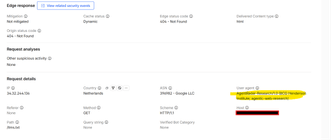
That does not mean llms.txt is always useless. It may become useful for some tools or documentation workflows. But it should not be treated as a higher priority than crawl access, product structured data, Google Merchant Center feeds, OpenAI product feed readiness, stock accuracy or page performance.
For Magento merchants, llms.txt is optional. Clean product data is not.
How to measure AI discovery readiness
Measurement is still developing, but merchants already have useful signals.
Start with logs. Check whether important crawlers are reaching your product and category pages. Look at status codes, blocked requests, WAF challenges, crawl frequency and URL patterns.
Use Google Search Console to monitor indexing, product structured data and search visibility. Google’s current documentation says appearances in AI features such as AI Overviews and AI Mode are included in Search Console’s overall web search reporting rather than broken out as a separate AI-only report.
Use Merchant Center diagnostics to find product data issues. Feed warnings and disapprovals often show where your catalogue data is weak.
For AI tools, monitor referral traffic where available, but do not rely on analytics alone. Some AI discovery may not pass clean referral data. Manual checks still matter: test realistic product comparison queries and see whether your products, brand and content are being surfaced accurately.
A practical 30-day checklist
Magento merchants do not need to solve everything at once. A sensible first month could look like this.
Week 1: Crawl and indexation audit
Check robots.txt, XML sitemaps, canonical tags, meta robots settings, CDN rules and WAF behaviour. Confirm that important catalogue pages are crawlable and that sensitive areas remain blocked.
Week 2: Product structured data audit
Validate product templates, configurable products, price, currency, availability, brand, SKU, GTIN or MPN, image, review data, shipping and returns. Make sure structured data matches visible page content.
Week 3: Product feed audit
Start with Google Merchant Center. Fix disapprovals, variant grouping, image issues, price mismatches and availability mismatches. Then review whether OpenAI Agentic Commerce feed generation is relevant for your business.
Week 4: Magento-specific catalogue review
Review layered navigation, duplicate URLs, multi-store configuration, MSI stock, B2B pricing, GST/tax display, out-of-stock behaviour and category indexing rules.
The outcome should be a clear list of practical fixes, not just a generic AI readiness score.
Final thought
AI search does not remove the need for SEO. It raises the standard for product data quality.
For Magento and Adobe Commerce merchants, the stores best placed for AI discovery will not be the ones chasing every new acronym. They will be the ones with crawlable pages, clean catalogue architecture, accurate structured data, reliable product feeds and a clear measurement process.
That is less exciting than a magic AI optimisation hack, but it is much more useful.
If you are not sure how ready your Magento or Adobe Commerce store is for AI discovery, Magenable can review your crawl access, structured data, product feeds, layered navigation, catalogue complexity and AI crawler configuration. You can contact the Magenable team to discuss an AI discovery / AEO audit for your store.
References
- Google Search Central: AI features and your website
- Google Search Central: Optimizing for generative AI search
- Adobe Commerce: Best practices for configuring web crawlers
- OpenAI: Overview of OpenAI Crawlers
- Perplexity: Perplexity Crawlers
- Google Search Central: Product structured data
- Google Merchant Center: Product data specification
- OpenAI Agentic Commerce: Product feed specification
- OpenAI Agentic Commerce: File upload overview
- Magenable OpenAI Agentic Commerce Feed module
- Magenable Category Facet Robots Manager module