Which ecommerce platforms do Australia’s top 100 online retailers use? (2027 edition)
2027 edition. This is the updated version of our research into the ecommerce platforms used by Australia’s top 100 online retailers, observed in November 2026. See how the market has shifted since our original 2016 study of Australian retailer platforms.
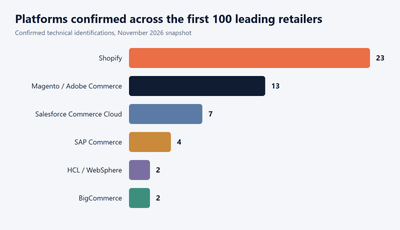
The short answer: Shopify now is the most common platform we could identify, but the picture changes as retailers get bigger. Among the first 100 entries in Power Retail’s Top Australian Online Retailers ranking, we confirmed Shopify on 23. The Magento / Adobe Commerce family came next on 13, and Salesforce Commerce Cloud on 7. At the very top of the market, no single platform dominates.
If you are choosing or replatforming an ecommerce store, it is genuinely useful to see what established retailers run. What is less useful is treating one platform as automatically “the best” because it appears most often. This research tells you what we found, what we could not confirm, and how to use that information sensibly.
Key findings: ecommerce platforms used by Australia’s top retailers
- Shopify leads overall. It was the most frequently confirmed platform across the whole register we reviewed (232 of 573 source entries).
- Big retailers are more mixed. In the first 100 entries, Shopify held 23 of 51 confirmed identifications — roughly 45%. Magento / Adobe Commerce (13) and Salesforce Commerce Cloud (7) also had meaningful presence.
- Magento is far from dead. Brands such as Bonds, Total Tools and The Athlete’s Foot run on the Magento / Adobe Commerce family.
- We could not identify everyone. Of the first 100, 39 were unknown and 10 only probable. That is a big share, so treat these numbers as a floor, not a complete census.
- Popularity is not a recommendation. What suits JB Hi-Fi will not necessarily suit a growing mid-market retailer.
What Australia’s top 100 online retailers are running
This chart shows the platforms we could confirm among the first 100 entries in Power Retail’s ranking of leading Australian online retailers.

| Platform | Confirmed among the first 100 | Examples we observed |
|---|---|---|
| Shopify | 23 | JB Hi-Fi, Country Road, The Good Guys |
| Magento / Adobe Commerce | 13 | Bonds, Total Tools, The Athlete’s Foot |
| Salesforce Commerce Cloud | 7 | Cotton On, Rebel |
| SAP Commerce | 4 | Priceline, Repco |
| HCL / WebSphere | 2 | Portmans, Peter Alexander |
| BigCommerce | 2 | Pushys, Pillow Talk |
Source of the retailer list: Power Retail, Top Australian Online Retailers (captured 9 November 2026). Platform identification: Magenable. Counts describe a defined research group, not the whole Australian market. Examples are observations from November 2026, not endorsements or client relationships.
Two things stand out. First, Shopify is clearly the most common — but it does not have the commanding lead it holds in the wider market (see below). Second, several well-known enterprise platforms — Salesforce, SAP, HCL — are concentrated in this top tier, which makes sense: they tend to serve larger, more complex retailers.
A big caveat: we couldn’t identify everyone
Honest research has to show what it could not confirm, and this matters when you read any platform study.

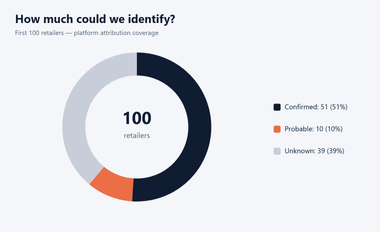
Of the first 100 retailers, we confirmed a platform on 51, judged 10 as probable, and could not identify 39. Many larger retailers deliberately hide or customise their technology, use a headless front-end, so “unknown” is common at the premium end. Any study that presents a clean percentage without acknowledging this gap is overstating its certainty.
The wider picture: Shopify dominates the long tail
We also reviewed the full 573-entry source register, which includes smaller and more varied retailers.

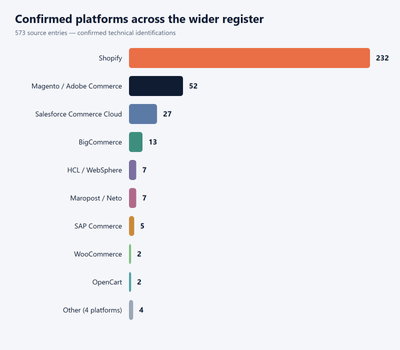
Across that wider register, Shopify was confirmed on 232 entries — far ahead of the Magento / Adobe Commerce family (52) and Salesforce Commerce Cloud (27). This long tail of smaller and mid-market retailers is where Shopify’s share of mind is strongest.
The insight that matters: the “enterprise gap”
The most useful finding is not “which platform wins” — it’s that the answer depends on who you’re looking at.

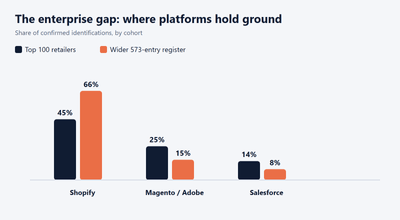
Shopify accounts for roughly 45% of confirmed platforms among the top 100, but 66% across the wider register. In other words, Shopify’s dominance grows as you move down the market, while Magento / Adobe Commerce and Salesforce hold proportionally more ground among the largest, most complex retailers.
For a business leader, this is the takeaway: the “most popular” platform depends on the segment you care about. If you benchmark yourself against the country’s biggest retailers, you’ll see a more even spread. If you benchmark against the broader market, Shopify appears far more dominant.
How this compares with our 2016 study
In February 2016 we ran the same exercise on the top 100 retailers listed in Power Retail’s 2015 E-Commerce Leaders’ Playbook. The source lists and methods differ, so read this as a direction of travel rather than a like-for-like trend line.
| Platform family | 2016 study (top 100) | 2027 edition (first 100) |
|---|---|---|
| Shopify | 0 | 23 |
| Magento / Adobe Commerce | 27 | 13 |
| Salesforce Commerce Cloud (Demandware in 2016) | 6 | 7 |
| SAP Commerce (Hybris in 2016) | 6 | 4 |
| HCL / IBM WebSphere Commerce | 9 | 2 |
| Platform not identified | 38 | 39 (plus 10 probable) |
The biggest change is Shopify: absent from our 2016 top 100, it is now the most common platform we can confirm. Magento remains the second-largest platform family at the top of the market, while older enterprise suites such as IBM WebSphere Commerce have declined sharply.
What this means for your platform decision
Popularity is a starting point, not a verdict. Before you commit, answer these questions honestly:
- What does your business actually need to sell? Subscriptions, trade accounts, complex pricing, large catalogues and B2B requirements push you toward more capable (and more costly) platforms.
- What must connect to it? Your ERP, point of sale, inventory, accounting and fulfilment systems have to integrate cleanly — this is often where the real cost and effort sits.
- Who will run it day to day? Match the platform to the skills and time your team actually has, not to a demo you were shown.
- What is the total cost over several years? Include licences, hosting, apps or extensions, implementation, integrations and ongoing support — not just the entry price.
- How will you measure success? Set your own targets for conversion, reliability and operating efficiency. This study does not rank which platform performs best.
A familiar logo in a research table is not evidence that the same architecture and operating model will suit your business.
For a deeper side-by-side view, see our B2B ecommerce platform comparison for 2026, our guide to choosing between open-source and SaaS ecommerce platforms, and our Magento vs Shopify feature comparison.
How we did this (in plain English)
We started with the live ranking of leading Australian online retailers published by Power Retail (Power Retail’s Top Australian Online Retailers), captured on 9 November 2026. The ranking, its scoring method and the retailer order are Power Retail’s work; the platform identification is ours. We reviewed the first 100 entries in detail, and a wider register of 573 source entries for broader context.
We identified each platform using a combination of public signals on the retailer’s website and recognised detection tools, then had an evidence review check the results. We only counted a platform as “confirmed” where the technical evidence was strong. Where we were not confident, we marked it “probable” or “unknown” rather than guessing.
We did not place orders, log into any accounts, or test checkouts. This is not a security or performance audit, and it does not measure market share by revenue — it measures what we could observe in November 2026.
Research notes
- Observation date: November 2026. The ranking was captured on 9 November 2026, UTC.
- What we measured: platform adoption within a defined group of retailers — not national market share, revenue, or platform quality.
- “Confirmed” means strong technical evidence of a platform, not a retailer’s endorsement or a licence audit.
- A note on family names: we group Magento and Adobe Commerce together, because public signals do not reliably distinguish the open-source edition from the paid one.
A more detailed technical report, including the full evidence methodology and the complete retailer-by-retailer dataset, is available as a separate PDF and CSV.
Frequently asked questions
What is the most popular ecommerce platform in Australia?
Shopify. In our November 2026 review it was the most frequently confirmed platform both among Australia’s top 100 online retailers (23 of 51 confirmed identifications) and across a wider register of 573 retailer entries (232 confirmed). This counts retailers, not revenue or market share.
Do large Australian retailers use Shopify?
Yes. JB Hi-Fi, Country Road and The Good Guys were among 23 of the top 100 Australian online retailers confirmed on Shopify in November 2026. Shopify’s share is lower at the top of the market, though: about 45% of confirmed platforms in the top 100, compared with about 66% across the wider register.
Is Magento still used in Australia?
Yes. The Magento / Adobe Commerce family was confirmed on 13 of the top 100 Australian online retailers and on 52 entries in the wider register, making it the second most common platform family. Examples include Bonds, Total Tools and The Athlete’s Foot.
Which ecommerce platform is best for an Australian retailer?
There is no single best platform. The right choice depends on your catalogue, B2B or subscription needs, the systems it must integrate with (ERP, POS, inventory), your team’s skills and the total cost over several years. Use adoption data like this as a starting point, then assess fit against your own requirements.
Choosing a platform for 2027?
Magenable helps businesses plan, build and improve stores on Magento / Adobe Commerce, BigCommerce and Shopify — from platform strategy and replatforming to integrations and ongoing support.
If you are planning for 2027, explore Magenable’s ecommerce services or talk to us about your requirements.
Download the research
Download the detailed technical report (PDF)
Download the retailer platform dataset (CSV)
Observations: November 2026. The CSV contains 573 source entries listed alphabetically, including uncertain and scope-issue cases; it is not a census of all Australian retailers and does not reproduce Power Retail’s ranking order.
Disclosure: Magenable provides commercial ecommerce services. This study applies the same evidence rules across all platforms, is not an endorsement of any platform, and does not claim that the retailers named are Magenable clients. Observations can change, so check the snapshot date before citing individual examples.