Robert Cialdini describes Reciprocity as our tendency to respond to a genuine “give” with a “give” of our own. In ecommerce, that response might be a purchase, a signup, a referral, or simply giving the brand a chance.
Reciprocity is often misunderstood as “risk reduction” or “nice branding”. The cleaner definition is:
Reciprocity = the merchant gives some value first (time, inventory, effort, expertise, access, or a useful asset) in a way that helps the customer before money changes hands.
When the brand gives first in a tangible way (even a small token), it signals goodwill — and customers are more likely to reciprocate by taking the next step.
Article series: Part 1 (Social Proof) -> Part 2 (Authority) -> Part 3 (Scarcity) -> Part 4 (Reciprocity)
What you’ll get:
- A practical Reciprocity framework that works across categories
- Examples you can use as screenshot references
- UX-first rules to keep reciprocity credible (not gimmicky)
What Reciprocity is (in ecommerce terms)
Reciprocity answers a different question to Scarcity.
“What can I give that helps the customer now — before asking them to commit?”
That “give” can be inventory (try-first), expert time (styling/consult), or a small token like store credit or a gift card. The gift doesn’t have to be big — sometimes it’s the simple fact that the brand gave something first that matters. Reciprocity is a social norm: when a customer feels they’ve been treated generously or fairly, they’re more inclined to respond by continuing the relationship — often by buying.
A practical classification of Reciprocity in modern ecommerce
Most reciprocity implementations fit into these buckets:
- Try-first & home try-on: the customer gets real product experience before committing
- Free expert help: real human guidance before purchase
- Gifts & credits: giving tangible value (birthday, “we miss you”, store credit)
- Reciprocal concessions: start with a bigger ask, then concede to a smaller one
Below is how each works, where to place it, and how to keep it credible.
1) Try-first & home try-on (the highest-impact form)
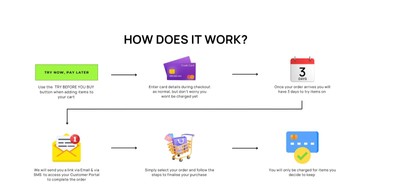
This is the strongest reciprocity pattern because the merchant takes on real cost and effort up front: inventory, shipping, returns logistics, and payment authorisations. Customers get the benefit first — trying at home in real life — and only pay after deciding.
Best practice:
- Explain the mechanics plainly (authorisation hold vs charge)
- Keep the trial window clear (e.g., “3 days to try”)
- Remove ambiguity: what happens next, how returns work, what’s considered “acceptable condition”
Avoid:
- Calling it “free” if the customer is actually charged
- Hidden fees or conditions buried in long FAQs
- Flows that are so complex the “give” becomes effort
Example: $0 upfront home try-on
Form and Fold clearly states the model: checkout with $0 upfront, then pay for what you keep. It also explains the pending card hold vs a charge.


Example: try up to 4 items at home
White & Co frames the value simply: try up to 4 items at home, with a payment hold and you only pay for what you keep.


Example: home try-on kit (category fit)
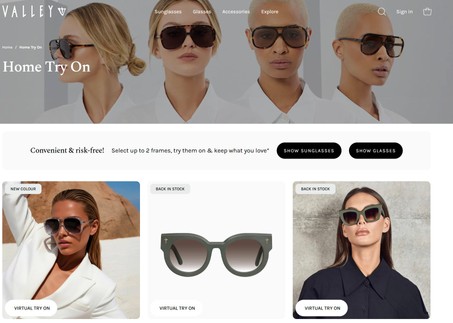
Valley Eyewear summarises the exchange clearly: select frames, try at home, keep what you love and return the rest. Home try-on is a variant of try-first that works well where in-person fit matters (eyewear, shoes, technical gear).

Example: payment holds explained properly
Melissa Shoes provides a clear explanation: the card is authorised to validate payment, but it isn’t a charge; the amount shows as pending until the customer decides what to keep.

2) Free expert help: invest human time before the sale
Free expert help is reciprocity when it is truly service-first: real guidance that makes the customer better off, even if they don’t buy on the day. This is especially effective in fit-sensitive categories and high-consideration purchases.
Taking Shape offers a free personal styling experience with no obligation. The value is the expertise and the personal preparation, not a discount.

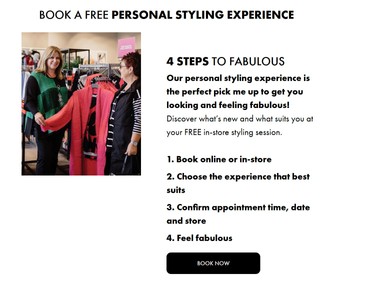
Implementation note: make the promise specific (what happens, duration, what the customer walks away with) and keep booking friction low.
3) Gifts & credits: tangible value that strengthens the relationship
Not all reciprocity needs to be operationally heavy (like try-first logistics). A straightforward alternative is a gift, credit, or voucher that feels personal and genuinely useful.
Where gifts and credits work well:
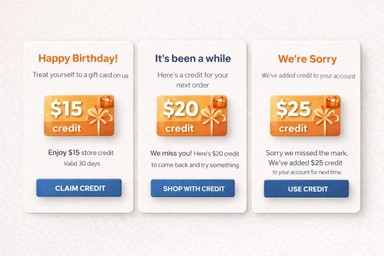
- Birthday gift (“Happy birthday — here’s $15 credit”)
- We miss you credit for lapsed customers (“Here’s $20 to come back and try something new”)
- Goodwill credit after a service issue (a real give that repairs trust)
- Gift cards / credit instead of discounts (often better perceived value and cleaner margin control)
Anaconda provides $20 birthday gift voucher to its loyalty club members.


UX-first rules:
- Keep it simple: clear amount, expiry, and where it applies.
- Make it feel intentional: avoid generic “10% off” if a credit fits better (“$15 credit” reads as a gift).
- Don’t punish loyal buyers: cap frequency, target lapsed segments, and avoid training people to wait.

Copy examples you can reuse:
- “Happy birthday — enjoy $15 store credit (valid 30 days).”
- “It’s been a while — here’s $20 credit to put towards your next order.”
- “Sorry we missed the mark. We’ve added $25 credit to your account.”
4) Reciprocal concessions: start big, then concede (Door-in-the-face)
This is the “concession” form of reciprocity: you begin with a larger ask, then if the customer declines, you retreat to a smaller, more reasonable option. The concession can trigger a subtle sense of “meeting halfway”.
Where it shows up in ecommerce:
- Upsell flows (premium add-on first, then smaller add-on)
- Bundles (bigger bundle first, then smaller bundle)
- Shipping thresholds (higher threshold first, then a lower offer if they hesitate)
- Cart abandonment recovery (full price first, then a “help you decide” concession)
Example pattern: premium add-on, then standard
Step 1 (big ask): “Add Pro Setup + Priority Support for $299.”
Step 2 (concession after decline): “No worries — Standard Setup is $79 if you don’t need the Pro package.”
Example pattern: cart abandonment recovery as a concession
Cart recovery can be a clean concession sequence if it is used sparingly and framed as “meeting you halfway” rather than bribing everyone.
- Big ask: customer sees full price and leaves checkout.
- Concession: follow-up offers a smaller ask: free shipping, store credit, or a limited discount to remove the blocker.
Recommended 3-step recovery sequence:
- Help first (no discount): “Did anything break? Here’s your cart. Shipping/returns info. Support if you need it.”
- Concession (conditional): “If price is the blocker, here’s free shipping / $15 credit / 10% off.”
- Final smaller ask: “Not ready? Save your cart or wishlist for later.”
UX-first rules for concessions:
- The first offer must be real (not an absurd anchor). Customers should be able to accept it.
- The concession must be genuine (the second offer is meaningfully smaller/cheaper).
- Avoid training: if customers learn they always get a discount, abandonment goes up long-term.
- Prefer “credit” over % off when possible: it feels like a gift and is easier to control.
- Segment: concessions are best for new customers, high-AOV carts, or lapsed customers — not everyone.
Measurement tip: track acceptance rate of the second offer and whether the flow increases cart abandonment. If the big ask feels pushy or the concession becomes predictable, you can lose more than you gain.
Where to use Reciprocity in the customer journey
Reciprocity works best where customers feel uncertainty or effort:
- Category / discovery: entry points like “Try before you buy”
- PDP: explain the give (trial window, payment hold, what happens next)
- Checkout: reinforce clarity (no surprise fees, timelines, conditions)
- Post-purchase: goodwill credit and helpful support can strengthen reciprocity
- Reactivation: birthday and “we miss you” credits for lapsed customers
UX-first rules for ethical Reciprocity
If you want reciprocity to lift conversion without eroding trust:
- Make the value immediate: the customer should benefit before paying
- Explain the mechanics plainly: authorisation hold vs charge, trial window, conditions
- Be specific: “Try 4 items for 3 days” beats “risk-free shopping”
- Keep conditions visible: fees, timelines, exclusions should be obvious
- Do not turn the give into a trap: the moment it feels sneaky, reciprocity collapses
Common anti-patterns (and why they backfire)
-
“Free” that isn’t free: calling it free while charging immediately or burying fees.
- Backfire: customers feel tricked; disputes and refunds spike.
-
Over-complication: too many steps, unclear timelines, or confusing authorisation holds.
- Backfire: reciprocity becomes effort, and customers opt out.
-
Concessions that become predictable: training customers to abandon carts for discounts.
- Backfire: abandonment rises and margin collapses over time.
-
Gifts that feel like bait: big promises with tiny print and harsh exclusions.
- Backfire: credits become distrust, not goodwill.
Quick implementation checklist
If you want to ship Reciprocity improvements without a huge rebuild:
- Build a clear Try Before You Buy page (how it works, holds, conditions, what happens next)
- Put the key mechanics on PDP: trial length, authorisation hold, returns conditions
- Introduce one expert-help channel (styling call, fit help, specialist chat) with a specific promise
- Add a credit/gift playbook (birthday + reactivation + goodwill)
- Implement cart recovery as a concession sequence (help first, then a targeted concession)
Measurement (do not fly blind)
- Landing page to PDP click-through (does the offer reduce uncertainty?)
- Checkout conversion rate for try-first vs standard checkout
- Return rates + reasons (fit issues should fall if reciprocity is working)
- Support tickets mentioning “pending”, “charged”, “hold”, “refund time”
- Cart recovery incremental lift vs trained abandonment trend
- Repeat purchase rate for customers who received credits (birthday/reactivation/goodwill)
Summary
Reciprocity isn’t “being nice”. It’s giving something real before asking for commitment.
- Try-first & home try-on (real experience before commitment)
- Free expert help (time and expertise given upfront)
- Gifts & credits (tangible value that strengthens the relationship)
- Reciprocal concessions (start big, then concede — including cart recovery)
This is Part 4 in our Cialdini series.
Next: Part 5 – Commitment & Consistency (how small steps lead to bigger ones).