Introduction: what is Model Context Protocol (MCP) in plain English?
Model Context Protocol (MCP) is an open standard that defines how AI applications connect to external systems—databases, APIs, tools, and files—through a consistent, secure interface.
Instead of building a different custom integration every time you want an AI assistant to talk to an internal system, MCP provides a common “language” and structure. Technically, it’s an application-layer protocol based on JSON-RPC that lets “MCP servers” expose tools and data, and “MCP clients” (AI apps like ChatGPT, Claude, etc.) call those tools during a conversation.

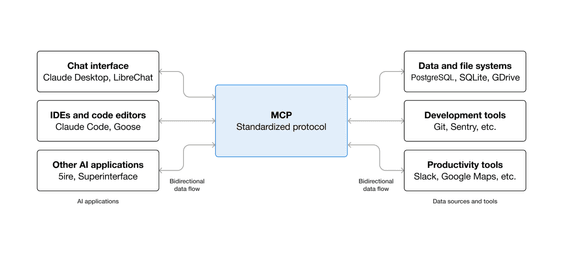
A popular analogy is that MCP is like USB-C for AI: any compatible AI assistant can plug into any compatible MCP server and start using its tools and data, without bespoke wiring each time.
Since late 2024, MCP has gained real momentum. It was introduced by Anthropic, then adopted or supported by OpenAI, Microsoft (Azure OpenAI), Google DeepMind and others—making it a strong candidate to become a standard way AI agents interact with business systems.
For online retailers, that matters because your AI projects no longer have to be one-off experiments with brittle glue code. You can build on a shared, growing ecosystem.
MCP in the ecommerce context
Ecommerce is a natural fit for MCP because online stores already run on structured, API-driven systems: product catalogues, checkout flows, inventory, customer records, and marketing platforms. AI assistants are increasingly expected to use this data in real time, which creates a need for a consistent way to connect AI models to these systems. MCP fills that gap by acting as a unified interface layer.
Across the industry, various players are now extending MCP into commerce:
-
Shopify has demonstrated how storefront APIs can be exposed through MCP, allowing AI agents to search products, check availability, or prepare carts in a controlled, permission-based way.
-
Independent MCP servers are emerging for multiple platforms (including Magento, BigCommerce, headless environments and custom stacks), enabling agents like Claude or ChatGPT to work with product data, orders, fulfilment information and customer profiles.
-
Analysts covering agentic commerce point to MCP as a key enabler for cross-system orchestration—letting AI agents perform tasks consistently across ecommerce platforms, CRMs, ERPs, WMS systems, and marketing tools.
-
Retail technology guides and implementation case studies show brands using MCP to streamline operations such as customer service, inventory coordination, merchandising support and omnichannel experiences.
The direction is becoming clear: MCP is evolving into a standard adapter layer between your commerce ecosystem and any AI agents you choose to deploy—whether that’s a storefront shopping assistant, a customer service copilot, or an internal analytics helper for merchandising and planning.
Key benefits of MCP for online stores
1. One integration layer instead of many
Today, an AI assistant that needs to:
-
read products from your catalog
-
check inventory
-
pull customer orders
-
trigger shipments or refunds
All that often requires separate custom integrations with your platform (Magento, BigCommerce, Shopify), CRM, ERP, WMS, etc.
With MCP, you can expose these capabilities as tools from one or more MCP servers. Any MCP-aware AI client can then use them, and you don’t have to re-build the plumbing when you change AI providers or add a new assistant.
2. Vendor flexibility and less lock-in
Because MCP is an open standard now supported across multiple major AI ecosystems, you’re less tied to a single vendor’s proprietary tool format.
If you expose “getProductBySKU”, “createCart”, “listOrdersForCustomer”, etc. via MCP, you can theoretically use:
-
Anthropic (Claude)
-
OpenAI (ChatGPT / Agents SDK)
-
Azure OpenAI
-
Future MCP-compatible providers
…without changing the underlying commerce integration, only the AI client and configuration.
3. Stronger governance and security
Retail/enterprise MCP guides highlight multi-user authorization models, delegated permissions and encrypted token management as central to enterprise adoption.
For an online store, this can translate into:
-
Clear limits on what AI agents can do (e.g., “can issue refund up to $100”, “read but not write customer data”).
-
Easier auditing of which tools were called for which request.
-
Safer experimentation—agents can work with realistic data via MCP but within tight permission scopes.
4. Better customer experience from truly “context-aware” AI
MCP allows shopping assistants to use live data—catalog, pricing, stock, promotions, customer history—rather than just static training data or manual exports. Examples include assistants that can:
-
Search your catalog with semantic understanding and your taxonomy.
-
Propose a cart and update it as the customer refines requirements.
-
Take into account reviews, sizing feedback, or purchase history when recommending products.
-
Surface add-ons or bundles that fit the customer’s current selection.
5. Real operational impact, not just “cool demos”
Retail-specific MCP pilots report:
-
Faster customer service resolution (up to ~40% in some early trials).
-
Double-digit conversion uplift from AI-augmented experiences in some cases.
Numbers will vary, but the direction is clear: when AI agents can act in your systems, not just chat, the impact goes beyond minor productivity gains.
Known ecommerce use cases for MCP
Below are practical ways retailers are already using MCP, along with a few uses that are easy to implement with today’s tools.
1. AI shopping assistants on your storefront
Using a Storefront-style MCP server (Shopify has a public example; Magento/BigCommerce can be wired similarly via custom servers), an AI assistant can:
- Search products using your existing search or PIM.
- Retrieve full product details and images.
- Build and modify a cart.
- Check inventory and variants in real time.
- Apply vouchers or check shipping options.
From a shopper’s perspective, they describe what they need; the assistant uses MCP tools to actually do the work in your backend.
2. Customer service copilot for support teams
An internal agent (embedded in your helpdesk or intranet) can, via MCP:
- Look up orders and their current fulfilment state.
- Pull shipment tracking from your logistics provider.
- Suggest refund or replacement options according to your policies.
- Draft replies that agents can review and send.
Because the assistant uses defined tools with permissions, you can keep risky actions (issuing refunds, changing addresses) behind manual approval while still saving a lot of handling time.
3. Content, SEO and merchandising automation
Marketing and merchandising teams can use MCP-enabled agents that connect to: product data, collection structures, search terms, analytics and SEO tools. Articles focused on MCP for Shopify SEO and ecommerce content show how MCP-connected agents can generate or improve:
- Product descriptions and FAQs using live attributes and stock.
- Collection and landing page copy aligned to real search queries.
- Internal linking suggestions between related products and content.
- SEO metadata at scale, with guardrails.
The advantage over a standalone “AI copywriter” is that the assistant can see exactly what’s in your catalog and how it performs.
4. Inventory, pricing and analytics assistants
MCP is not limited to storefront APIs. Vendors like Anthropic and Microsoft show MCP connecting to databases, BI tools, and other back-office systems.
For ecommerce, that means you can have agents that:
- Query sales by SKU, channel, or campaign from your data warehouse.
- Flag low-stock or overstock situations.
- Suggest pricing tests or markdown candidates.
- Surface anomalies (e.g., sudden return spikes for a product).
Instead of asking your data team for an ad-hoc report, staff can ask a governed AI assistant, which in turn uses MCP to query the right sources with the right filters.
5. Omnichannel and “agentic commerce” workflows
Analyses of agentic commerce emphasise AI agents that autonomously orchestrate tasks across multiple systems—email, ads, ecommerce platform, CRM, POS, etc. MCP provides the glue layer to make those interactions consistent.
Examples:
- A retention agent identifies “at-risk” customers, pulls their purchase behaviour, then triggers a discount email through your ESP.
- A B2B agent prepares draft quotes by combining ERP price lists with ecommerce cart data.
- A marketplace agent audits product data across channels and proposes fixes.
All of these are easier when each system is exposed via MCP tools instead of bespoke integrations.
What’s next: platform-specific deep dives
This article is intentionally platform-agnostic. In follow-up pieces, we’ll look at:
-
MCP for Magento Open Source / Adobe Commerce – patterns and code-level examples for exposing Magento as MCP tools.
-
MCP for BigCommerce – where to hook into APIs, and how it plays with headless setups.
-
MCP for Shopify – leveraging Shopify’s emerging MCP ecosystem and Storefront integrations.
These will be more technical and hands-on, aimed at teams working closely with developers or agencies.
Getting help: working with Magenable
If you’re an online store owner or manager, MCP might feel a bit abstract right now. You don’t need to become a protocol expert to benefit from it, but you do need a solid plan and careful implementation.
Magenable is an ecommerce consultancy specialising in Magento Open Source / Adobe Commerce, BigCommerce, Shopify and AI-driven enhancements. We can help you:
-
Identify practical MCP use cases for your store.
-
Design an MCP architecture that fits your existing stack.
-
Work with your development team (or ours) to implement and test MCP servers and AI assistants.
If you’d like to explore MCP for your business, you can get in touch with us